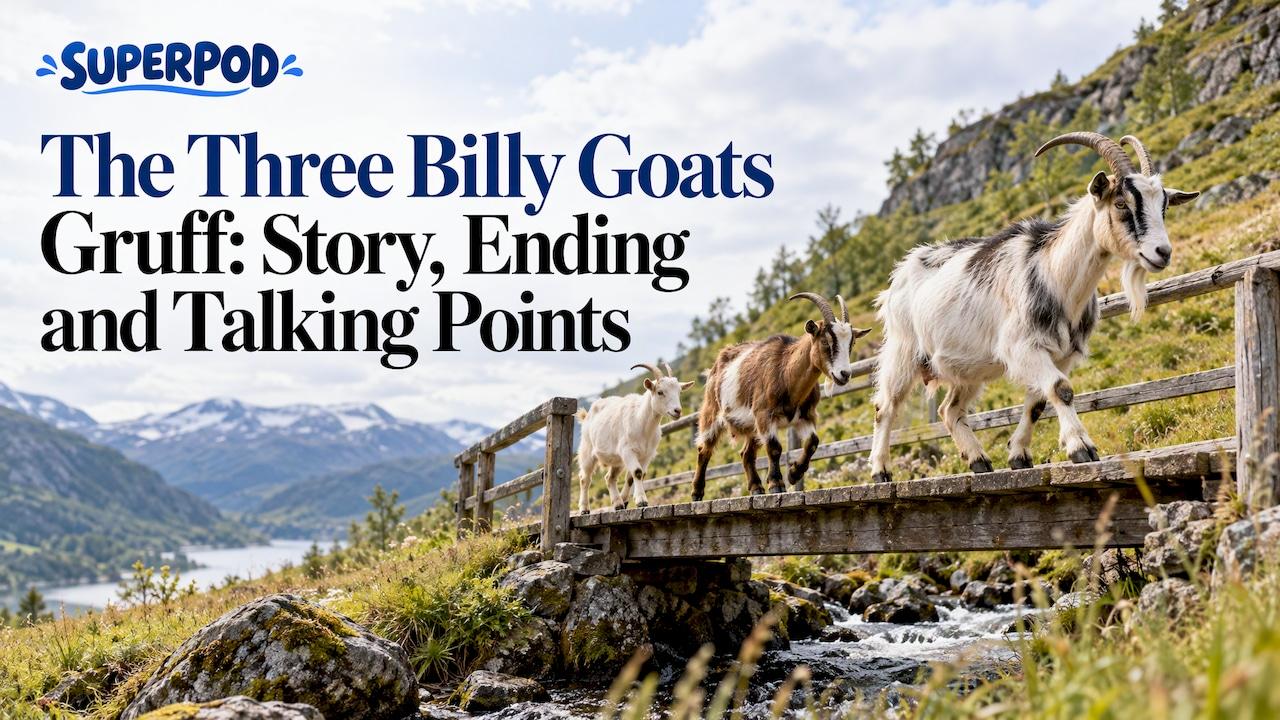
The Three Billy Goats Gruff is a Norwegian folktale about three goat brothers who need to cross a bridge to reach a hillside of green grass. A hungry troll lives under the bridge. The two smaller goats talk their way past him by promising a bigger meal is coming, and the biggest goat finally knocks the troll into the water. Below you will find the full story in plain words, how it ends in different versions, where it comes from and questions that turn a quick read-aloud into a real conversation about fear, courage and fairness.
TL;DR
- Three goats named Gruff want to cross a bridge to a hillside. A troll under it wants to eat them.
- The smallest and middle goats each say "wait for my bigger brother." The biggest goat fights the troll and sends him into the stream.
- The tale was collected in Norway and first printed in the 1840s. Modern picture books soften or change the ending.
- It works best for ages 3 to 5, and it suits older kids when you ask what the goats and the troll could have done differently.
- Good talking points: being scared, taking turns, using your brain before your strength, and how bullies can change.
Table of Contents
- The story in plain words
- How The Three Billy Goats Gruff ends
- Where the story comes from
- Retellings your child may meet
- What the story teaches
- How to read it aloud
- Questions to talk about together
- Is it too scary for young kids?
- A calm next story for the same ideas
- Ways to use the tale at home and in class
- FAQ
- Sources
The story in plain words
Once there were three billy goats, and the family name of all three was Gruff. A billy goat is simply a male goat. There was a little one, a middle one and a big one. They lived on a bare hillside where there was hardly anything to eat, and they could see a lush mountain pasture on the other side of a stream. The only way across was a wooden bridge.
Under that bridge lived a troll. In folklore, a troll is a big, grumpy creature from Scandinavian tales who often lives in wild places such as mountains and under bridges. This one had eyes like saucers and a nose as long as a poker, according to the 1912 English text of the tale, and he was ready to gobble up anyone who crossed.
The smallest goat goes first
The little goat starts across, trip-trap, trip-trap. The troll pops up and asks who is crossing his bridge. The little goat answers in a tiny voice that it is only him, and that he is going up to the hillside to make himself fat.
The troll says he is coming to gobble him up. The little goat begs him not to, because he is too little. He tells the troll to wait a bit for the second billy goat, who is much bigger. The troll thinks about it and lets him pass.
The middle goat follows
Next the middle goat crosses, with a louder trip-trap, trip-trap. The troll makes the same threat. The middle goat makes nearly the same plea: wait for the big billy goat, who is much bigger. The troll, still hoping for a larger meal, lets him go too.
The big goat finishes it
Then the biggest goat crosses, and his hooves go trip-trap, trip-trap with a heavy thump. When the troll threatens him, he does not beg. He is ready to fight. In the 1912 text, he butts the troll with his horns and tosses him into the stream. Then all three goats climb the hillside, eat until they are very fat, and the tale closes with the old storyteller's sign-off, "Snip, snap, snout. This tale's told out."
How The Three Billy Goats Gruff ends
The ending is the part parents ask about most, because it changes from book to book.
The traditional ending. In the Dasent translation printed in 1912, the big goat pokes out the troll's eyes, crushes him and throws him into the stream. The goats then get so fat on the hillside that they can hardly walk home. That is a rough ending by modern picture book standards.

The softened ending. Many versions for young children skip the gore. The big goat simply bucks the troll off the bridge and he splashes into the water. The troll is gone and the bridge is safe.
The kinder ending. Jerry Pinkney's picture book goes further. According to Common Sense Media's review, the biggest goat butts the troll into the water, and the art suggests the troll later builds a new house on the rocky side. The troll and goats end up finding a way to live in peace.
If your child is on the sensitive side, you can choose the ending that fits. Reading the softened ending aloud is a normal choice, since the story has been retold for generations, and you can always tell your child it is a very old tale that people tell in different ways.
Where the story comes from
The tale is Norwegian. The University of Michigan Library's online exhibit on animal tales identifies it as an oral folktale collected by Peter Christen Asbjørnsen and Jørgen Moe, whose folktale collection first appeared in 1841 and was reprinted many times. "Oral" means people told it out loud for years before anyone wrote it down, which explains why so many versions exist.
The troll is the clue that points to Scandinavia, where trolls are a staple of folklore. The goats are almost always brothers, though some retellings make them a family of different ages. In English retellings, "Gruff" is treated as the goats' surname, which is why the title says "Billy Goats Gruff" and not "Gruff Billy Goats." Kids often love knowing that the name is part of the fun: all three are Gruff, but they are different sizes.

Retellings your child may meet
Because the plot is simple, authors love to play with it. A few examples:
- Illustrated classic retellings. The University of Northern Iowa Libraries' guide to variations lists Roberta Arenson's 2001 illustrated version, in which three goats cross a rickety bridge toward a troll and a stream.
- Comic twists. The same guide lists Mac Barnett and Jon Klassen's funny "fractured fairy tale," in which a hungry troll imagines ways to cook the goats. These work well for kids who already know the original and enjoy spotting what changed.
- City versions. The University of Michigan exhibit describes an urban adaptation by Emberley that swaps the troll for a rat and the bridge for a sewer crossing.
If your child knows the plot well, ask them to invent their own version. Who lives under the bridge? What are the goats trying to reach? Even a three-year-old can tell you the troll should be a dragon or a crab.
What the story teaches
The story has no lecture in it, which is why it lasts. The lessons sit in what the goats do.
Courage comes in different forms
The little goat is brave because he walks onto the bridge at all, even though he is small and scared. The big goat is brave in another way, by standing up to the troll. Kids who feel small can recognize themselves in the first goat. Kids who are big for their age can think about when to use strength and when to be careful.
Thinking can beat a threat
The two smaller goats do not win by force. They use words and a clever idea. It is also fun to notice the troll's mistake: he could have eaten the first goat right away, but he got greedy for a bigger dinner. That is a small, concrete way to talk about how greed can backfire.
Bullies and second chances
The troll is a bully who blocks a path everyone needs. Jerry Pinkney said he wanted the story to be more than a cautionary tale or a revenge story, and Common Sense Media's review notes that his version invites conversations about greed, bullying and chances to change. Whichever ending you read, you can ask your child what should happen to the troll and why.
Feelings before the crossing
Every goat has to cross while feeling afraid. That makes the story a gentle way to name a feeling that most small children know well: being nervous about something you have to do anyway.
How to read it aloud
This is a story made for voices. A few simple tricks make it better.
- Give each goat a sound. Use a tiny voice for the smallest goat, a medium one for the middle goat and a deep one for the biggest. Kids love predicting who comes next.
- Tap the rhythm. "Trip-trap, trip-trap" is a drumbeat. Tap your knees, and let the taps grow louder with each goat.
- Slow down before the troll speaks. A pause builds suspense without making the story scarier.
- Choose the ending in advance. Decide whether you are reading the traditional or a softer version, so you are not improvising when the troll goes into the water.
- Stop one beat early. Let your child say the last line or shout the goats' reply with you.
For children ages 2 to 3, keep it short and focus on the sounds and the repeated pattern. For ages 4 to 6, add questions. For ages 7 and 8, invite them to act it out, rewrite the ending or explain why the troll's plan did not work.
Questions to talk about together
A story is more useful when you stop and wonder about it. Pick two or three, not all of them.
- How do you think the little goat felt when he stepped on the bridge?
- Why did the troll let the first goat go?
- What else could the goats have done to get to the hillside?
- Was the troll hungry, mean, or both? Is there another way he could have found food?
- Have you ever felt too small or too scared to do something? What helped?
- If you were the troll, what would you do after the goats left?
- Which goat are you most like today?
For teachers, these questions fit neatly into circle time. Ask students to act out the three crossings, then draw the moment they find most exciting and write one sentence about how that character felt. The tale's repeating structure also makes it a good first story for sequencing: first, next, last.
Is it too scary for young kids?
For most children, the tale is more silly-suspenseful than frightening, because the repeated pattern tells them what to expect. One retelling summary recommends the tale for ages 3 to 5. Some very young or sensitive children still find the troll upsetting, especially at bedtime.
A few ways to keep it comfortable:
- Read it in daylight first, then at bedtime once your child knows how it goes.
- Choose a softer ending, or the Pinkney version in which the troll finds a new home.
- Give the troll a goofy voice, not a growly one.
- Say out loud that the goats are safe at the end and are now eating grass on the hillside.
If your child keeps asking for it again and again, that is normal. Repetition helps small children feel in control of a scary idea.
A calm next story for the same ideas
Many families who enjoy classic tales like this one also want calmer stories for winding down, with the same themes of courage and friendship but a softer pace. That is what we make at SuperPod.
SuperPod is a kids' podcast for ages 2 to 8 about Kiko, a curious young orca who goes on gentle adventures. Each episode combines original storytelling, calm music and ocean facts, with themes of courage, friendship and belonging that help children talk about their feelings. We also offer free guides and activity books, including read-aloud scripts and companion guides for parents and teachers, so a story can lead into a conversation after the episode ends. SuperPod is a father-daughter collaboration.

If you liked talking about bravery and being scared with the goats, you can listen to Kiko's stories at SuperPod and pick up the free guides for your home or classroom.
Ways to use the tale at home and in class
- Make a bridge. Lay a strip of tape or a plank on the floor. Kids take turns being a goat, saying the lines in the right voice, while another child plays the troll.
- Order the goats. Cut out three paper goats in small, medium and large sizes and have children put them in order. This builds early math language like bigger and smaller.
- Retell with new characters. Swap the goats for sea animals and the troll for a grumpy crab, and see what the new characters say.
- Draw the feeling. Ask children to draw how the little goat looked at the start of the bridge and at the end of the day.
- Practice kind words. Ask what the goats could say to the troll if they wanted to share the bridge, then act it out.
FAQ
What is the story of the Three Billy Goats Gruff?
Three goat brothers want to cross a bridge to a hillside with good grass, but a hungry troll lives underneath it. The smallest and middle goats each persuade him to wait for a bigger brother. The biggest goat fights the troll and sends him into the stream, and the goats feast on the hillside.
How does the Three Billy Goats Gruff end?
The biggest goat knocks the troll off the bridge and into the water, and the goats go up to the hillside to eat. In the 1912 English text the fight is violent, while many picture books for children soften it. Some versions let the troll survive and change.
What does "Gruff" mean in the title?
In English retellings, Gruff is the goats' family name, so each one is a Billy Goat Gruff. The word also sounds like a rough, deep voice, which is why many readers give the biggest goat a low growl. Either way, it is part of the story's fun.
Where is the Three Billy Goats Gruff from?
It is a Norwegian folktale, collected by Asbjørnsen and Moe in a book first published in 1841. It was told aloud for years before that, which is why you will find so many versions today.
Sources
- Popular Tales from the Norse: The Three Billy-Goats Gruff (1912 text, Wikisource)
- A Menagerie of Animal Tales: The Three Billy Goats Gruff (University of Michigan Library)
- The Three Billy Goats Gruff: Variations on Favorite Tales (University of Northern Iowa Libraries)
- The Three Billy Goats Gruff: Parents' Guide and Book Review (Common Sense Media)
- The Three Billy Goats Gruff (Indian Folk Tales)