
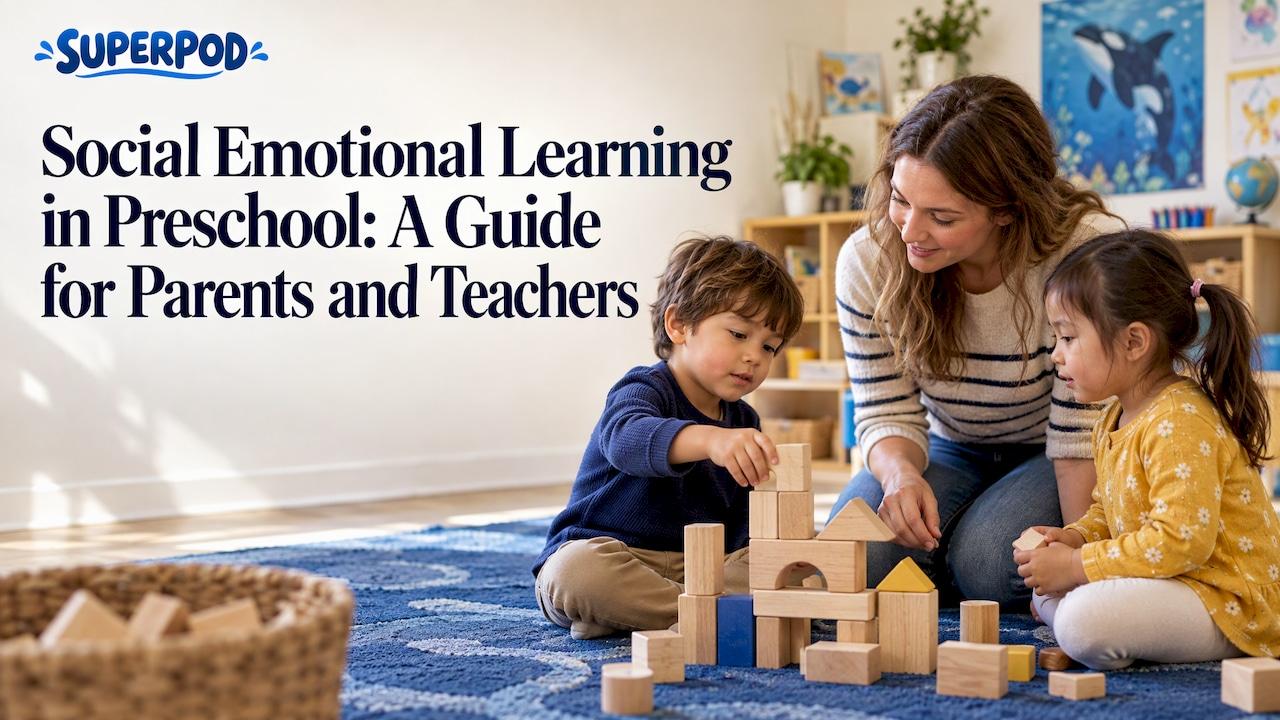
Social emotional learning in preschool is the everyday work of learning to name feelings, calm down, take turns and get along with others. Children build these skills through trusted adults, play and repeated practice, and stories are one of the easiest ways to start the conversation. This guide explains what the skills are, why they matter, and which activities you can try this week at home or in a classroom.
TL;DR
- Social emotional learning (SEL) in preschool covers three big areas: getting along with others, understanding feelings, and managing big emotions.
- Children learn these skills mainly through warm, consistent relationships with adults and through play, not through worksheets.
- Stories, songs, puppets and pretend play give children a safe way to talk about feelings that are hard to name in the moment.
- Short, repeated routines work best: a feelings check-in, a bedtime story conversation, a turn-taking game.
- SuperPod's calm orca stories for ages 2 to 8 come with free parent and teacher guides to help you keep the conversation going after each episode.
Table of Contents
- What social emotional learning means for a preschooler
- Which skills preschoolers are building, and why they matter
- Relationships come first
- Why play and stories work so well
- Simple SEL activities to try at home or in class
- When a child struggles with big feelings
- Where SuperPod fits in
- For educators: fitting SEL into a busy preschool day
- Frequently asked questions
- Sources
What social emotional learning means for a preschooler
Social emotional learning is the process of building the skills that help a child understand feelings, relate to other people and handle strong emotions. Head Start describes these as skills children can learn and practice, such as getting along with others, understanding feelings, regulating big emotions and solving problems.
You will also see the phrase social emotional development. It points to the same territory. Development is what happens as a child grows; learning is what adults do on purpose to support it. In preschool the two are almost impossible to separate, because a three-year-old learns about feelings while stacking blocks, sharing a snack or losing a game.
The U.S. Department of Education's guide for early childhood providers groups this area into three parts:
- Social interaction: taking turns, helping friends, playing together and cooperating.
- Emotional awareness: recognizing and understanding your own feelings and actions and those of other people, including how they affect you and others.
- Self-regulation: calming yourself and managing behavior when feelings run high.
That three-part frame is useful because it tells you what to look for. A child who grabs a toy needs help with social interaction. A child who melts down and cannot say why needs help with emotional awareness. A child who knows she is angry but cannot settle needs help with regulation.
Which skills preschoolers are building, and why they matter
NAEYC, the National Association for the Education of Young Children, lists skills preschoolers show as they grow: recognizing and managing emotions, empathy, expressing preferences, following directions, building relationships, and playing, negotiating and compromising with others. The same article notes that social and emotional health affects children's overall development and learning, and that mentally healthy children tend to show greater motivation and take part more eagerly in class.
In plain terms, here is what that looks like at different moments of a preschool day.
| Moment | Skill in action | What it sounds like |
|---|---|---|
| Two children want the same truck | Negotiating, taking turns | You can have it after me. |
| A child is upset at drop-off | Naming feelings, seeking comfort | I feel sad. I want Mommy. |
| A tower falls over | Persisting, managing frustration | Let's build it again. |
| A friend cries | Empathy, caring response | Are you okay? Do you want a hug? |
| Circle time | Group participation, following directions | Waiting for a turn to talk |
NAEYC's family guide adds that social development helps children get along, respect others, work together, build language and self-control, and resolve conflicts with a teacher's support. Emotional development, it explains, includes understanding your own and others' feelings, managing feelings and behavior, showing concern, trying new things and sticking with hard tasks.
There is also a clear age pattern. A University of Washington course-book chapter says that between ages 3 and 5 children develop more complex communication for cooperative play, including creating shared goals. That is why a four-year-old can plan a pretend restaurant with friends, while a two-year-old mostly plays alongside them. Expect progress, not perfection: a preschooler can know the rule about sharing and still shout when a friend takes the last crayon.
Relationships come first
Before any activity, the biggest driver of SEL is the relationship between the child and the adults around them. Head Start says secure, consistent and trusting relationships help children feel comfortable learning new social and academic skills, and that predictable learning environments give them a safe place to grow.
NAEYC's 2018 article reports that children with trusting teacher relationships are, on average, more willing to ask questions, solve problems, try new tasks and express their thinking. The Department of Education's guide also points out that valuing children's cultures and languages, and building positive relationships, helps children feel safe and secure, which lays the foundation for healthy social emotional development.
What does that mean for your daily routine?
- Keep routines steady. Greet the child the same way each morning. Use the same goodbye ritual. Predictability tells a small child the world is safe.
- Respond to feelings without judgment. Ohio's preschool resource guide advises responding to emotions without judgment, supporting children as needed, and recognizing that families differ in what counts as acceptable emotional expression.
- Narrate your own feelings. Say, I am feeling a bit frustrated, so I am going to take a deep breath. Children copy what they see adults do.
Why play and stories work so well
Preschoolers do not learn about feelings from lectures. They learn by doing and by watching. NAEYC's article on guided play says play offers active, engaging and socially interactive experiences connected to children's lives, and that guided play, where an adult gently shapes the experience, shows promising learning and developmental outcomes.
Stories fit naturally into that picture. A character who feels nervous on the first day somewhere new lets a child talk about nervousness at a safe distance. Asking, How do you think she feels? is far easier for a four-year-old than asking, How do you feel? The University of Washington chapter describes emotional labeling, putting a word to a feeling, as supporting emotion recognition, regulation strategies and social problem-solving. A story hands children the words.
NAEYC's home-skills guide recommends exactly this: bedtime-story conversations about characters' feelings and choices, puppet play around conflicts, and thinking aloud to model coping and problem-solving.
Simple SEL activities to try at home or in class
You do not need a curriculum to start. Head Start's everyday ideas include emotion-face guessing, feeling check-ins, emotion songs, puppet scenarios and asking how story characters feel. Here is how to turn those into a routine.
Feelings check-in (2 minutes)
At breakfast or circle time, ask each child to point to a face showing how they feel today. Pictures of people showing different feelings are a classic tool; the University of Arkansas preschool strategies guide recommends them alongside emotion books and songs. Accept every answer. The goal is naming, not fixing.
Story conversation (5 to 10 minutes)
After any story, ask three questions: What happened? How did the character feel? What did they do that helped? Then connect it to real life: Has that ever happened to you? Keep it light. If a child wants to move on, let them.
Turn-taking games
Michigan's parent guide for ages 3 to 5 suggests practicing turn-taking during puzzles or sandbox play and talking about waiting while taking deep breaths. NAEYC adds that card, board and outdoor games create chances to practice turns, cooperation and handling frustration, and it advises focusing on fun rather than winning.
Puppets and pretend play
Michigan's guide recommends puppets, dress-up and pretend play to practice seeing another person's perspective and to talk through everyday situations and feelings. Try a puppet who is scared to try the slide, and ask the child to give the puppet advice. Children often say to a puppet what they cannot yet say about themselves.
A calm-down corner
The Arkansas guide suggests a relaxation station with soft materials or calm music. Keep it inviting, never a punishment. Teach children to go there on their own: three slow belly breaths, a soft toy, a quiet song.

Small shared jobs
Head Start's list also includes sharing small chores and using snack time, outdoor play or classroom centers to practice conversation and cooperation. Carrying the napkins together or watering a plant as a pair gives children a real reason to cooperate.
When a child struggles with big feelings
Every preschooler has meltdowns. What helps is a consistent adult response. The Department of Education's guide recommends that adults acknowledge difficult feelings, help children use words to describe them, model emotion words and teach positive ways to manage strong feelings. Adults can also use daily activities to practice turn-taking and cooperation and help children role-play positive ways to solve problems.
A simple script you can use in the moment:
- Get low and stay calm. Your steady tone is the first lesson.
- Name it. You are really angry that the tower fell.
- Offer a strategy. Let's take three deep breaths together. Ohio's guide recommends modeling regulation this way, for example by taking deep breaths when you are frustrated yourself.
- Solve the problem together. Do you want to rebuild it, or take a break first?
Prevention helps too. NAEYC recommends heading off predictable conflicts by putting away toys a child does not want to share and by explaining upcoming routines step by step. A child who knows what comes next has fewer reasons to panic.
If a child's behavior seems far outside what you see in other children the same age, or you are worried about their wellbeing, talk with your child's pediatrician or your program's early intervention team. They can look at the whole picture.
Where SuperPod fits in
The activities above all depend on one thing: a moment where an adult and a child can talk about feelings calmly. Story time is one of the most reliable of those moments, and that is why we created SuperPod.
SuperPod is a podcast for ages 2 to 8 built around Kiko, a curious young orca who goes on gentle adventures. Each episode combines original storytelling, calm music and ocean facts, with themes of courage, friendship and belonging. It is made by a father and daughter, and our stories are designed to help children process their feelings while they learn about the ocean.

Listening is only the first half. For parents, the free parent guides and activity books give you questions and ideas to start real-life conversations after an episode. For teachers, the free teacher guides and read-aloud scripts help you bring Kiko's stories into circle time or a calm-down corner. You can find the episodes and guides at SuperPod Kids.
A sample week with a story
Here is how a family or classroom might use one episode, borrowing the routines above:
- Monday: Listen together and do a quick feelings check-in afterward. How did Kiko feel? How do you feel?
- Tuesday: Retell the story with puppets or stuffed animals. Let the child be Kiko.
- Wednesday: Pick one ocean fact from the episode and look at pictures of that animal. Nature curiosity is a calming way to build attention and language.
- Thursday: Practice one coping skill from the story, such as slow breaths, during a quiet moment, not during a meltdown.
- Friday: Ask, When was a time you felt brave this week? Celebrate small answers.
The point is repetition. Children learn emotional vocabulary the same way they learn any vocabulary: by hearing it often, in warm moments, from people they trust.
For educators: fitting SEL into a busy preschool day
Teachers rarely have an hour for a stand-alone SEL lesson, and they do not need one. Embed practice in what already happens:
- Arrival: a feelings check-in at the door or on a chart.
- Circle time: a short story, song or puppet scenario followed by two or three questions.
- Centers: a pretend-play area with dress-up and puppets where children rehearse sharing and problem-solving.
- Snack and outdoor play: natural times to practice conversation, turns and cooperation.
- Transitions: explain what comes next step by step, and use a calm song or breathing pause to settle the group.
Because trusting relationships make children more willing to ask questions and try new things, your most powerful SEL tool is how you greet, listen to and respond to each child. The activities simply give those interactions a shape. Families can then echo the same language at home, which makes the skills stick. Sending a short story-conversation prompt home is an easy way to link the two.
Frequently asked questions
What is the difference between social emotional learning and social emotional development?
Development is the natural growth of a child's social and emotional abilities. Learning is the intentional support adults give to that growth, through relationships, play and practice. In preschool the two overlap so much that the terms are often used interchangeably.
At what age should children start SEL?
Social emotional learning starts in infancy, through responsive and loving care. In preschool, around ages 3 to 5, children can use more words, play cooperatively and plan with friends, so activities like feelings check-ins, puppets and story conversations become especially useful.
How can I teach SEL at home without a curriculum?
Use routines you already have. Talk about characters' feelings at bedtime, name your own feelings out loud, play simple turn-taking games and explain what comes next in the day. Short daily moments add up more than occasional long lessons.
Can a podcast really help with social emotional learning?
A story gives a child and an adult a shared example to talk about. When the episode features a character facing worries or conflicts, you can pause, ask how the character feels and connect it to your child's day. The listening is the spark and the conversation afterward is the learning.
How do I help a child who gets overwhelmed by frustration?
Stay calm, name the feeling, offer a simple strategy such as deep breaths, and solve the problem together once they settle. Practice the strategy at quiet times so it is familiar when emotions run high.
Sources
- Social and Emotional Learning, Head Start
- Fostering Healthy Social and Emotional Development in Young Children, U.S. Department of Education
- Promoting Young Children's Social and Emotional Health, NAEYC
- What Do Children Learn in a High-Quality Preschool Program?, NAEYC
- Preschool Social and Emotional Development, University of Washington
- The Case of Brain Science and Guided Play, NAEYC
- Everyday Ideas for Increasing Children's Opportunities to Practice Social Skills, Head Start
- Social and Emotional Development for Preschoolers (3-5), Michigan
- Strategies and Activities for Preschool, University of Arkansas
- Building Social and Emotional Skills at Home, NAEYC
- Social and Emotional Development Preschool Resource Guide, Ohio