
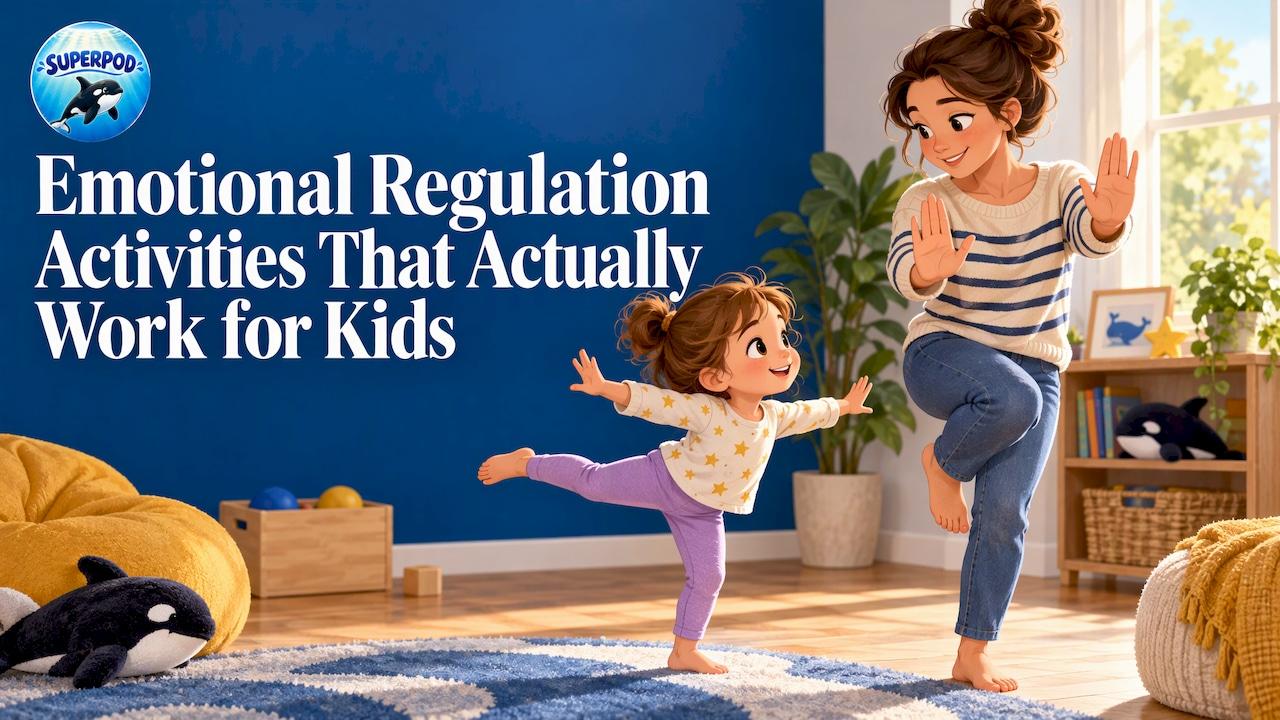
Kids don't learn to handle big feelings by being told to calm down. They learn by practicing, over and over, when nothing is on fire. The best emotional regulation activities are small, playful and a little silly: a freeze dance, a bubble-blowing session, a story where a character gets scared and figures it out. Below you'll find ideas that work for ages 2 to 8, plus how to use a story (like the ones on our podcast about Kiko the orca) to get kids talking about what's going on inside.
Key Takeaways
- Practice when everyone's calm. Games like Freeze Dance and Simon Says build the same skills kids need during a meltdown.
- Name the feeling first, fix the behavior second. "You're really frustrated" beats "Calm down" every time.
- Your calm is the main tool. Kids borrow it before they can make their own.
- Stories are a shortcut. Talking about a character's feelings is way easier for a kid than talking about their own.
- Keep it light. Five minutes of play beats a twenty-minute lecture.
Table of Contents
- What emotional regulation actually means for a little kid
- The five steps, kid-sized
- Games that sneak in self-control
- Breathing and body activities for big-feeling moments
- Sensory and creative outlets
- Use stories to talk about feelings
- Match the activity to the age
- How to teach it without getting preachy
- Where Kiko fits in
- FAQ
- Sources
What emotional regulation actually means for a little kid
Emotional regulation is just the ability to feel something big and not get swept away by it. For a preschooler, that might mean being mad about a broken cracker and getting to "I'm mad" instead of a full floor-flop.
The timeline is long. A guide for early childhood educators notes that most kids learn to self-regulate somewhere between ages three and seven, and that babies and toddlers lean on familiar adults to do it with them. That's called co-regulation, and it's the reason a calm grown-up is worth more than any worksheet.
So if your four-year-old melts down over the wrong color cup, that's not a failure of parenting or a bad kid. It's a skill that's still under construction.
The five steps, kid-sized
People often ask about the "5 steps of emotional regulation." There are a few versions floating around. One of the clearest for parents of young kids comes from the Raising Children Network, which lays out five steps for helping a child calm down: notice the emotion, name it, pause, support your child while they settle, then deal with the problem.
Here's how that looks in real life:
- Notice. Clenched fists, a wobbly lip, sudden yelling. You spot it before it peaks if you can.
- Name it. "You're mad the block tower fell down." Short and plain.
- Pause. Say nothing for a few slow seconds. It feels weird. It works more than you'd think.
- Stay close. Be the calm one. Sit nearby, breathe slowly, repeat the feeling word if needed.
- Solve it. Once the storm passes, rebuild the tower or talk about what to do next time.
Naming is the step most of us skip. One early childhood guide points out that lines like "Stop crying" or "Calm down" don't do much to change how a child feels, and suggests swapping in "I see that you are really frustrated." Easy swap, big difference.
Games that sneak in self-control
These are the "practice when it's calm" activities. Kids think they're playing. They're actually stopping, starting, waiting and switching gears, which is the whole job.
Freeze Dance and Red Light, Green Light
ZERO TO THREE calls these games co-regulation disguised as fun. Put on music, dance wild, freeze when it stops. For Red Light, Green Light, let your kid be the leader sometimes. Giving them the power to say "stop" is half the fun.
Simon Says (with silly moves)
Same idea: listen closely, hold back when Simon didn't say it. The extension service at the University of Nebraska–Lincoln lists Simon Says, freezing games, and a red-light version with reversed rules as ways kids practice self-regulation through play. Flipping the rules (go on red, stop on green) is hard and hilarious.
Emotion walking
Head Start's everyday ideas for building emotional skills include a walking game: ring a bell, and everyone walks like they're sad, then mad, then super excited. It gives kids a safe way to feel what those emotions look like in a body. The same page suggests singing a familiar song in different emotions, like a grumpy "Twinkle Twinkle" or a scared "Happy Birthday."
Emotion charades
Take turns acting out a feeling using something real: "I dropped my ice cream." The other person guesses. It works for toddlers (with help) and for school-age kids who want a challenge.
Pretend play
Dolls, stuffed animals and dress-up count. Nebraska's guide says pretend play gives kids a safe space to practice planning, imagining other people's views and deciding what to do about a feeling, like comforting a doll that feels scared. If your kid keeps putting their teddy in timeout, that's useful information about what's on their mind.
Breathing and body activities for big-feeling moments
These are the tools to teach before you need them. Kids can't learn "deep breaths" while they're screaming, so practice at bedtime or during a quiet afternoon.
- Bubble breathing. ZERO TO THREE suggests blowing bubbles together to "blow our big feelings out." A slow, long breath is the trick, and bubbles make kids do it without noticing.
- Glitter calm-down jar. Shake it, watch the glitter settle, breathe until it's still. It's a handy visual for little ones who can't count breaths yet.
- Playful yoga. Have kids invent a pose for each emotion: arms up to the sky for happy, curled up small for sad. A UK early years booklet turns this into a story game, where kids move into the matching pose whenever an emotion shows up in a short tale.
- Heavy work. The American Academy of Pediatrics lists body movement like trampoline jumping and bear hugs among play ideas to help kids manage emotions. The AAP's advice is to figure out what gets your kid "back to green," because it differs from child to child.
- Mindful listening. Close your eyes for one minute and count the sounds: the fridge hum, a siren, a bird. The same booklet makes it a friendly competition, then kids share how the sounds made them feel.
Sensory and creative outlets
Some kids can't talk about it yet. Their hands can do the talking.
The AAP suggests setting up a "let it out" zone: a blank journal for drawing feelings, a tub of modeling clay to squish, a dress-up basket, or a box of pots, wooden spoons and rice shakers. Young kids often work through feelings by drawing, dressing up or making noise before they can find the words.
Sensory bins, water play and sand all slow kids down. A preschool teacher writing for Edutopia describes using a tub of warm soapy water for a child who needs to decompress, with the adult sitting alongside. If you want more on why hands-on play helps, there's a good rundown of sensory play and child development that covers drawing, clay, music and calm spaces.

Make a calm corner (without making it a timeout)
A cozy spot with cushions, a favorite stuffie and a few books gives a kid somewhere to land. The one rule that matters: it's voluntary. The UK booklet is clear that a calming corner should never be used as punishment. Let your kid name it and decorate it. Something like "Cam's Comfy Corner" with a hand-drawn sign gets them invested, an idea from an at-home SEL guide for pre-K.
Use stories to talk about feelings
Here's a trick every parent ends up learning: kids will tell you how a character feels long before they'll tell you how they feel. Use that.
Head Start recommends pausing in any storybook to ask how characters feel, then having kids make a face or act it out. In Goldilocks, for example, the bears are surprised, Goldilocks is curious, and somebody is definitely scared. Then bring it home: "Have you ever felt like that?"
A few easy story questions:
- How do you think they feel right now?
- What could they try?
- What would you do?
- What if the story ended differently?
That last one comes from the UK booklet's storytime activity, which also suggests connecting the story to the child's own life and inventing new endings. If you want a classic to practice on, our write-up of The Three Billy Goats Gruff comes with talking points. And if your kid's headed to kindergarten, we've got tips on picking a podcast and easy SEL activities.
Pretend play with animals works too. PBS KIDS notes that acting like different animals is one more dramatic play option, which is a great excuse to waddle around the living room like a penguin and ask how the penguin feels.
Match the activity to the age
A two-year-old and a seven-year-old need very different things. A rough guide, based on University of Nebraska–Lincoln Extension's age breakdown and ZERO TO THREE:
| Age | What helps | Try this |
|---|---|---|
| Toddlers (1 to 3) | Feeling labels, comfort, redirection, other ways to express it | Bubble breathing, cozy corner, feelings books, "You're mad the tower fell" |
| Preschoolers (3 to 5) | More feeling words, stories, role-play, spotting triggers | Emotion charades, playful yoga, pretend play, story questions |
| Early elementary (5 to 8) | Choosing a strategy themselves, practicing it | Calm-down menu, goal-setting, rule-flipping games, talking through story characters |
The last row is our rule of thumb rather than a research finding. The pattern is the same, though: toddlers need you doing it with them, and older kids can start picking their own tools.
One more thing: what works for one kid won't work for another. Squeezing a stress ball, flapping hands or going for a walk can each be someone's thing, and that's fine. Let them test a few and keep a short list of favorites.
How to teach it without getting preachy
Some low-effort habits do a lot of the work:
- Narrate your own feelings. PBS KIDS for Parents suggests saying things like "I'm feeling a little overwhelmed, so I'm going to take a brain break." Kids copy what they hear.
- Do a daily check-in. At dinner, try the Head Start sentence: "Today, I felt ___ when ___ happened." Share yours first.
- Coach, don't command. A federal practice brief on self-regulation in the first five years describes the adult as a coach: show the skill, support practice, and cheer small wins, all inside a warm relationship.
- Give unstructured play time. The UK booklet recommends at least an hour a day of free, screen-free play where kids pick what to do.
- Name feelings with words they know. Keep it simple at first: happy, sad, mad, scared, surprised, calm. For ideas on building emotional vocabulary and modeling coping at home, this piece on teaching empathy to preschoolers is handy.
If you're a teacher, our guide to social emotional learning in preschool goes deeper on classroom routines.
Where Kiko fits in
SuperPod is a kids' podcast for ages 2 to 8 about Kiko, a curious young orca who goes on gentle ocean adventures. Each episode mixes original storytelling, calm music and ocean facts, with themes like courage, friendship and belonging. It's a father-daughter project, and it's built to give kids a feelings-friendly story you can listen to together and then talk about.

We also make free parent and teacher guides, read-aloud scripts and activity books, so you've got ready-made questions to ask after an episode. Hit play on the SuperPod podcast when you want a story to listen to together, or browse the free guides for grown-ups for talking points. If you want to support what we're building, take a look at Founding Families.
FAQ
What are some simple emotional regulation activities for toddlers?
Keep it physical and short. Freeze Dance, bubble blowing, a glitter calm-down jar and a cozy corner all work, and so does simply naming the feeling out loud ("You're mad the tower fell"). Toddlers need a grown-up to do these with them, since they borrow your calm.
How do I teach self-regulation to a preschooler?
Practice during calm moments with games like Simon Says, emotion charades and playful yoga. Narrate your own coping ("I need a brain break"), and use story characters to talk about feelings. Praise effort rather than perfect results.
Should I send my child to a calm-down corner when they melt down?
Offer it, don't enforce it. A calm corner works best as a place a child picks, decorates and chooses to visit, and it shouldn't be used as punishment. Sit nearby if they want you there.
What are the five steps of emotional regulation for kids?
One kid-friendly version: notice the feeling, name it, pause, stay close while they settle, then solve the problem together. The naming step is the one most adults skip, and it matters most for little kids.
At what age do kids learn to regulate their emotions?
It's gradual. Babies and toddlers rely on adults, and most children build real self-regulation between roughly ages three and seven. Meltdowns at four aren't a sign something's wrong, just that the skill is still growing.
Sources
- Strategies for Helping Young Children with Self-Regulation (University of Nebraska–Lincoln Extension)
- Everyday Ideas for Increasing Children's Opportunities to Practice Social Skills and Emotional Competencies (Head Start)
- Your Calm Is Their Calm: Co-Regulation Strategies (ZERO TO THREE)
- Calm and in Control (Gryphon House look-inside)
- Helping children calm down: 5 steps (Raising Children Network)
- Promoting young children's self-regulation skills through play (booklet)
- 4 Play Activities to Help Children Manage Emotions (HealthyChildren.org, AAP)
- Sensory Play in Preschool Helps Promote Calm (Edutopia)
- Social-Emotional Learning at Home Activities for PreK
- Act It Out: Dramatic Play for Kids (PBS KIDS for Parents)
- NEBLINE, May 2025 (University of Nebraska–Lincoln Extension)
- Supporting Independent Kids With Practical Self-Management Strategies (PBS KIDS for Parents)
- Promoting Self-Regulation in the First Five Years (Administration for Children and Families)
- Sensory Play and Child Development: A Parent's Guide
- How to Teach Empathy to Preschoolers at Home
Recommended
- Social Emotional Learning in Preschool: A Guide for Parents and Teachers
- Podcasts for Kindergarteners: How to Pick One (Plus Easy SEL Activities)
This is not professional advice, we are simply creators with a passion for sharing.