
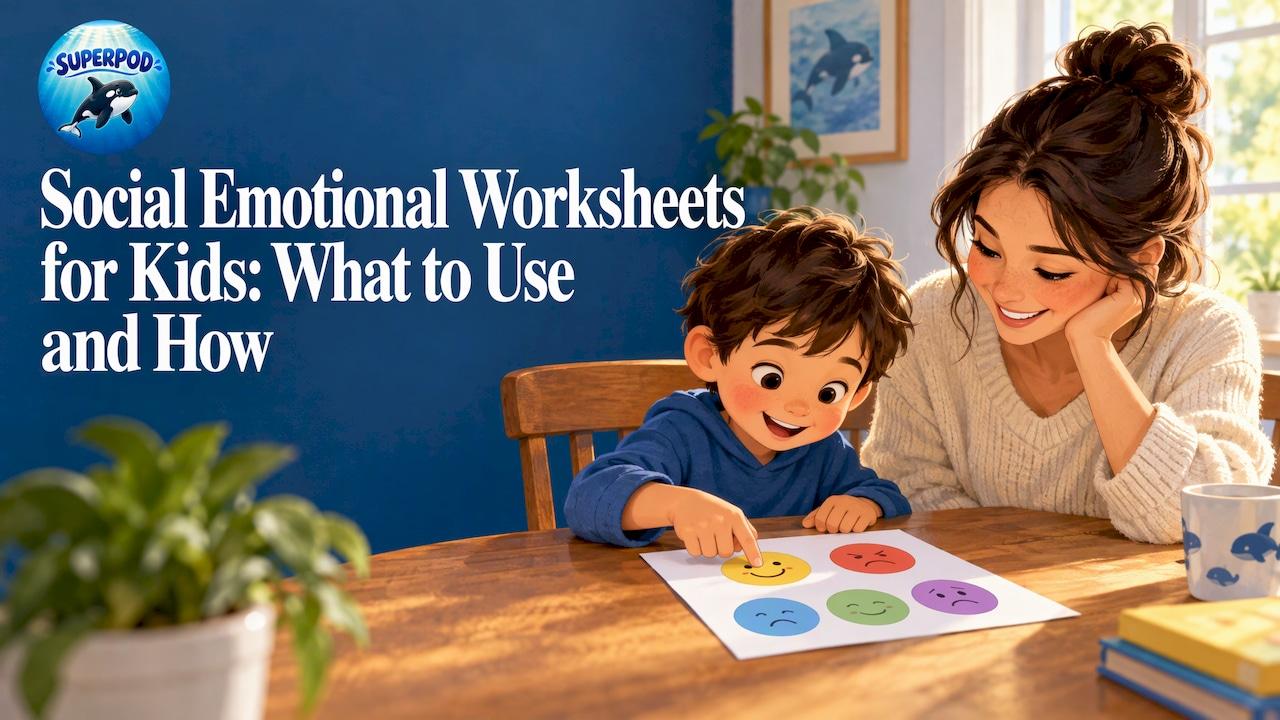
Here's the short version: the best social emotional worksheets for little kids are the simple ones. Think feeling faces, a mood thermometer, a daily check-in, and a few friendship prompts. They work best when a grown-up sits next to the kid and talks, and when something fun, like a story, sets the mood first. That's the approach we take at SuperPod, where our calm orca podcast about Kiko comes with free parent and teacher guides, read-aloud scripts and activity books built to start those same conversations.
Below you'll find the worksheet types worth printing, how to match them to your kid's age, and how to use them without turning feelings time into homework.
Key Takeaways
- Start with feelings basics (faces, thermometers, check-ins). Fancier sheets on empathy and conflict can wait until a kid has words for what they feel.
- For ages 2 to 5, skip anything that needs lots of reading. Matching, pointing, drawing and talking count as the "worksheet."
- The sheet is a prop. The real work is the conversation: ask when they last felt it, what happened, and how they feel now.
- Do it when your kid is calm, keep it short, and don't correct every answer.
- Pairing a story with a sheet gives kids a character to talk about, which is easier than talking about themselves.
Table of Contents
- What "social emotional" actually means (in one minute)
- The feelings worksheets worth printing first
- Worksheets for specific skills
- How to pick the right one for your kid
- Turning a worksheet into an actual conversation
- Setting up a calm-down corner
- Why a story makes the worksheet work
- A simple 10-minute routine you can steal
- For teachers: fitting worksheets into the day
- FAQ
- Sources
What "social emotional" actually means (in one minute)
Social emotional learning, or SEL, is just teaching kids to understand their feelings, handle them, and get along with other people. The DC Office of the State Superintendent of Education lays out five SEL competencies: self-awareness, self-management, social and cultural awareness, relationship skills, and decision-making and agency.
That sounds big, but at home it looks like this:
- Self-awareness: "I'm feeling mad right now."
- Self-management: "I'm going to take a big breath and squeeze my pillow."
- Social awareness: "Oh, my friend looks sad."
- Relationship skills: "Want to take turns?"
- Decision-making: "I'll tell the teacher instead of grabbing it back."
Worksheets are one way to practice these in bite-size pieces. If you want the bigger picture for the preschool years, we wrote a guide on social emotional learning in preschool for parents and teachers.
The feelings worksheets worth printing first
If you only grab a few, grab these. Almost every feelings printable you'll find is a version of one of them.
Feeling faces
A page of faces with a word under each: happy, sad, mad, scared, surprised. Kids point, match or circle. It's the easiest entry point because nobody has to read or explain anything yet. Child Mind Institute's preschool guide suggests activity sheets that match feeling words like mad, happy, scared and surprised to faces, and they can be used in school or at home.
For kids who can't read yet, cut-and-paste or sticker versions work great. The kid matches by looking at the face, and you say the word out loud. That's the whole lesson.
Mood thermometer
A thermometer runs from cool and calm at the bottom to hot at the top. The kid colors in or marks where they are right now. Samaritans NYC's free mental health worksheets for kids include a Mood Thermometer for marking how you feel and noting what to do about it. Pair it with a second prompt like "what could help when it's up here?" and you've got a self-regulation lesson hiding inside a coloring page.
"Your feelings" boxes
The same Samaritans NYC packet has fill-in boxes where a child draws or writes about a time they felt happy, angry, disappointed, worried, embarrassed, confused, silly, proud, loved or brave. For younger kids, drawing works fine and you write the caption they dictate. It's a nice one for the 5 to 8 crowd, since it connects feelings to real moments in their own day.
Daily check-in
A one-page "how am I feeling today?" sheet. Print one, slide it into a plastic sleeve, and use a dry-erase marker so it's reusable. Check in at breakfast, then again at bedtime. Kids get surprisingly into seeing the answers change.
Feelings vocabulary ladder
Once a kid has "mad," "sad" and "happy" down, give them more words. A ladder sheet puts words in order by intensity: annoyed, mad, furious. Kids this age often say "mad" for everything, and a wider vocabulary gives them something more precise to say.
Worksheets for specific skills
Once the basics feel easy, you can branch out. Here's what's out there, sorted by skill. Most are aimed at roughly kindergarten and up.
| Skill | What the worksheet looks like | Good for |
|---|---|---|
| Self-awareness | Feeling faces, body-scan "where do I feel it?" outlines, strengths and interests lists | Ages 3 to 8 |
| Self-regulation | Breathing steps, a calm-down choice chart, a thermometer with "what helps" boxes | Ages 3 to 8 |
| Empathy | "How does this character feel?" scenes, "walk in someone's shoes" prompts | Ages 5 to 8 |
| Friendship | Step-by-step cards like how to join in or make a new friend, greeting boards | Ages 4 to 8 |
| Conflict | Sentence starters ("I feel... when... because... I need..."), problem-solving steps | Ages 6 to 8 |
The California Teaching Pyramid, a state-backed early childhood program, shares free classroom materials including an emotions set and feeling wheel, feeling faces charts, scripted stories for social situations, and conflict resolution and problem-solving steps. Some are in English, Spanish and Chinese. Its friendship materials include greeting boards and a schedule template for fitting friendship moments into the day, which is handy for classrooms.
One thing worth knowing for preschoolers: Child Mind Institute points out that impulsive reactions to big feelings are normal at this age, and they're a good opening to talk about using words and settling small conflicts. So if your 4-year-old still grabs the toy, that's not a sign the worksheet failed. That's the exact thing you're practicing.
How to pick the right one for your kid
No need to overthink this. Three quick filters:
- Can they read? If not, choose sheets built on pictures, matching, drawing or pointing. If yes, add short sentence-completion prompts.
- What's going on this week? Lots of meltdowns? Go for the thermometer and calm-down choices. Trouble at school with friends? Try a friendship or conflict sheet. One sheet, one need.
- Does it look fun to them? A kid who loves animals will go further with a sheet where the characters are sea creatures than with a generic chart. Interest does half the work.
If you want a quick benchmark, DC's guide describes self-awareness as recognizing, understanding and expressing your emotions and seeing how they affect what you do, plus knowing your own strengths, interests and values. Any sheet that helps with one of those is doing its job.
And don't stress about grade labels. A "K to 2" sheet might suit a curious 4-year-old with your help, and a "grades 2 to 5" sheet might feel babyish or too wordy depending on the kid. Try one, see how it lands, and swap if needed.
Turning a worksheet into an actual conversation
This is the part most printables skip. A filled-in sheet doesn't teach much on its own. The talking does. Here are a few simple, research-backed ways to do it.
Use the "faces of feelings" move. For K to 2, the DC guide suggests having your child pick an emotion from a faces poster, talking about when they last felt it and what caused it, then describing how they feel right now and why. You can do that with any feelings sheet in about three minutes.
Ask about friends. The same guide suggests asking things like why they enjoy spending time with a particular friend after school, which gets kids thinking about what makes a good friend. For grades 3 to 5, it describes a "sandwich technique" for friendship conflicts: a compliment, then the issue, then a positive close.
Do I do, we do, you do. Sesame Workshop's SEL session plans use a three-step sequence: you model the feeling or strategy first, you practice together, then the child tries alone or with a buddy. So fill in the first box yourself ("I felt nervous when the dentist called my name"), do the second one together, and let them take the third.

Repeat it. Sesame's booklet recommends reinforcing a strategy across multiple videos, at least eight times. The takeaway for the rest of us: don't expect one worksheet to stick. Coming back to the same idea in different forms is the point.
Try conversation starters. Yale's RULER for Families offers at-home prompts for grades 2 to 3, such as asking each other how you're feeling at different points of the day and writing down feeling words you come across in books you read together. That second one is a super easy way to make a vocabulary list that's actually yours.
Keep it light
A few ground rules that make worksheet time feel like a break instead of a chore:
- Pick a calm moment. Nobody reflects well mid-meltdown.
- Keep it to five or ten minutes.
- Ask curious questions ("Tell me more about that one") instead of fixing every answer.
- Let them draw instead of write, or skip a box.
- End with one small, realistic next step, like "next time I'll ask for a hug."
Child Mind Institute puts the whole philosophy simply: all feelings are okay to have, and what matters is what we do with them. It also recommends validating the feeling before you jump into problem-solving, so "you're really frustrated" comes before "here's what we can do."
Setting up a calm-down corner
A worksheet gets a lot more useful when there's a place to go with the feeling. Child Mind Institute suggests a designated calm-down space with strategies like squeezing a stress ball, hugging a stuffed animal, drawing or blowing bubbles. Tape a thermometer or a "what helps me" chart to the wall there, and the sheet becomes part of the routine.
Breathing is the easiest strategy to teach, and music makes it more fun for little ones. These breathing with music activities are a good fit for a classroom routine or a home corner.
For the youngest kids, who don't have the words yet, sensory play can do the talking. This guide to sensory play and child development covers ways to help young children get through big feelings before they can put them into sentences.
Why a story makes the worksheet work
Here's something most parents figure out fast: kids will rarely say "I felt left out at recess" on command. But they'll happily tell you how a character felt. A story gives them a safe stand-in.

That's the idea behind SuperPod. Our podcast follows Kiko, a curious young orca, on gentle adventures for ages 2 to 8. Every episode mixes original storytelling, calm music and ocean facts, with themes like courage, friendship and belonging. After an episode, you can ask the same questions a feelings sheet asks, just about Kiko first: "How do you think Kiko felt when that happened? Have you ever felt like that?"
We also make free guides and activity books for families and educators, including parent and teacher guides and read-aloud scripts, so there's something ready to go after the story ends. Start at SuperPod Kids and look through the episodes and grown-up resources.

If your kid is a kindergartener, our post on podcasts for kindergarteners has easy SEL activities to go with listening time.
A simple 10-minute routine you can steal
Want something you can do tonight? Here's a no-prep version.
- Listen or read (3 minutes). Play a short story or read a picture book. Let the kid get cozy.
- Check in (2 minutes). Put out a feelings faces sheet. "Which face is closest to how you feel right now?"
- Talk about the character (3 minutes). "Which face would Kiko pick?" Then flip it: "When did you last feel that?"
- Pick a tool (2 minutes). "What helps when you feel like that?" Write or draw one answer. Done.
Do it a few nights a week and the sheets pile up into a little record of how your kid has been feeling. Spot a pattern, like lots of "worried" on Sunday nights? That's a great thing to talk about, and it came from a page and a few minutes.
For teachers: fitting worksheets into the day
If you're in a classroom, worksheets slot nicely into routines you already have. Morning meeting is a natural home for a check-in. A calm-down corner can hold the thermometer and a choice chart. Small groups can work through a friendship or empathy scenario together. And you can send a weekly goal or feelings sheet home so families have something to talk about at dinner.
Keep in mind that these are teaching tools. If a child is struggling a lot with their feelings or behavior, a school counselor, pediatrician or licensed child therapist is the right person to talk to, and worksheets are a supplement to that support, not a replacement.
FAQ
What are social emotional worksheets?
They're printable activities that help kids name their feelings, manage them and get along with others. Think feeling faces, mood thermometers, check-ins and friendship prompts. They work best when a grown-up talks through them with the child.
What age are SEL worksheets good for?
Picture-based sheets, like matching faces to feeling words, work for preschoolers, often with a grown-up helping. Kids in kindergarten through second grade can add drawing and short sentences. Conflict and perspective-taking sheets usually suit ages 6 and up.
How often should we do them?
A few short sessions a week beats one long one. Five to ten minutes is plenty. Coming back to the same ideas in different ways helps them stick, so repetition is a feature, not a flaw.
Do we need worksheets at all?
Not strictly. Flashcards, drawing, stories and daily check-in questions all do the same job. Worksheets are just a handy way to give the conversation some structure, and they make it easy to look back at how your kid's been feeling.
Sources
- DC OSSE SEL Parent, Family and Caregiver Guide
- Child Mind Institute PreK Educator Guide
- Samaritans NYC Mental Health Worksheets for Kids
- California Teaching Pyramid classroom materials
- Sesame Workshop SEL Session Booklet
- RULER for Families conversation starters, grades 2 to 3
Recommended
- Social Emotional Learning in Preschool: A Guide for Parents and Teachers
- Podcasts for Kindergarteners: How to Pick One (Plus Easy SEL Activities)
- The Three Billy Goats Gruff: Story, Ending and Talking Points
This is not professional advice, we are simply creators with a passion for sharing.